


Every beauty business owner or manager must retain customers and generate enough revenue to stay in business. A large part of achieving this requires you to set the right price for your salon or spa services.
Pricing is one of the most important details about your business as it influences how customers perceive your salon or spa.
For example, if your prices are too high for your target customers, they might consider your salon overvalued. On the other hand, if you set your prices too low, customers might question the skills of your employees and the quality of your services.
Getting your salon or spa pricing right means striking a balance between a pricing strategy that will keep you profitable and won’t turn away your target market.
It’s not always easy to do, especially as a new business. But it’s possible.
In this article, we’ll explain why it’s essential to set the right price for your salon or spa, list some pricing strategies to consider, show you some factors that determine pricing, and offer some tips on setting the right prices for your beauty business.
Why is setting the right price for beauty services crucial?

Pricing is a big deal to customers, which makes it a critical aspect of your business. In our previous article discussing why clients visit beauty establishments, pricing ranked number one.
Customers consider the prices of your salon and spa services before they visit. In a way, pricing influences customer acquisition and retention. All you need is the right pricing strategy for your target customers.
This brings us to the next question:
What is a pricing strategy?
A pricing strategy is a comprehensive approach beauty businesses use to decide what prices to charge for their products and services.
Typically, it involves understanding the target market, assessing customer demand, evaluating operational costs, and setting competitive prices.
5 common pricing strategies for beauty businesses in Nigeria
The following are five types of pricing strategies to consider:
#1. Penetration pricing

Using this pricing strategy means setting a low price for your services to attract customers, particularly those whose purchasing decisions mainly depend on price. There’s usually a plan to raise the prices later.
Penetration pricing is largely effective for new beauty businesses looking to break into a competitive market and build a large customer base quickly.
In the long run, however, it can pose some challenges. For example, customers who expect constant low prices may stop doing business with you once you increase them.
#2. Skimming pricing
This strategy is the opposite of penetration pricing. It entails setting high prices at first, then lowering them later.
Beauty businesses use price skimming when introducing novel products or services with no competition. Examples may include a rare massage that can only be gotten at your spa or a line of homemade natural hair care creams available only at your salon.
Skimming pricing is an effective way to attract customers with high purchasing power. On the other hand, you’ll attract price-sensitive customers when the prices reduce eventually.
#3. Value-based pricing

This pricing strategy employs a more customer-centric approach.
It involves setting the price of a product or service based on the perceived value it provides to customers, rather than on the cost of production or market prices.
Businesses that intend to use this approach must have a deep understanding of their clients well, making it suitable for established salons.
#4. Competitive pricing
Competitive pricing describes setting prices based on what your competitors are charging.
For this strategy to work, you need to know what other salons and spas in your market are doing, price-wise, and make any necessary adjustments.
While finding out what your competitors charge can be useful for getting an idea of what to put your prices, it’s not advisable to simply replicate their pricing
#5. Cost-plus pricing

With this strategy, you calculate everything it costs to bring the product or service to market and add a fixed percentage to arrive at a price. It’s also known as mark-up pricing.
Beauty retailers, manufacturers, distributors and other intermediaries tend to find the cost-plus pricing simple and time-saving.
Now that you know what a pricing strategy means and the common types in Nigeria, let’s see the major factors that can influence beauty business pricing.
What are factors that can influence salon and spa pricing strategy?
The following are four variables to consider when setting prices for your salon or spa services:
Factor 1: Location

Location is a crucial factor to consider when setting prices.
The reason is simple:
The majority of your customers, at least at first, will come from your surrounding location. And the socioeconomic status or purchasing power of these people will determine if your prices are too low, too high, or just right.
For example, a nail studio at the heart of an upscale area like Lekki Phase 1, Lagos, will typically charge more for nail care services than another nail salon in a low-end location like Ikorodu, Lagos.
Before you set your prices, do a proper location study.
Factor 2: Expenses
How much does it cost to bring your services to your target market?
I’m talking expenses in terms of variable costs like product used, tool purchase, employee training, and fixed costs like rent, salary, utility, marketing, maintenance, taxes, etc.
Consider these costs when you create your salon pricing strategy. Ensure your prices cover these expenses and leave enough after your break-even point (BEP) for profits.
As a newbie in the beauty industry, it can be tempting to discount your prices heavily. While offering initial discounts might seem effective for getting the first bookings and growing your customer base, remember you still need to pay bills. And if you plan to maximise profitability, you can’t charge less than you spend.
Factor 3: Demand
Which of your salon or spa services and products are in high demand and which are not?
Once you’re clear on who your target customers are, where they stay, and their lifestyle, you’ll know which beauty services are the most popular among them. When you have a basic idea of the services with a higher demand, you can adjust your prices accordingly.
Research other salons or spas in your niche or location to gain useful insights into what’s popular and what’s not. Check social media to see what’s trending.
Factor 4: Prevailing market prices
The beauty industry is a highly competitive market.
Find out the average prices for the services in your niche and location when creating your own.
For instance, you can’t have your barbing salon in a low-income neighbourhood and charge like salons in upscale areas. If customers see that your prices are way above the average in your niche or location, they might not visit.
That said, undercharging is just as bad. Besides the low chances of profiting, customers might view your salon or spa as inferior.
8 tips on charging the right price for your salon and spa services
Here are practical tips to help you price your beauty services effectively:
Tip 1: Know your numbers

The first step in correctly pricing your services is to understand your costs.
Salon and spa costs include fixed costs like rent, utilities, taxes, and salaries; variable costs such as supplies, products used, and employee training; and hidden costs like maintenance and unexpected expenses.
Whatever you decide to charge, ensure it covers your running cost, helps you break even, and ultimately turns a profit.
Tip 2: Consider your target market
Your pricing will be ineffective if your target customers can’t afford it. If that continues, it’ll run you out of business before you know it.
Understand your target market’s demographics, spending habits, and purchasing power and align them with your pricing strategy. If your target market is high-end clients, your prices should reflect the premium nature of your services, and vice versa.
Tip 3: Analyse your competitors

Looking up your competitors will give you valuable insights about what’s obtainable in your niche or location. Now, you don’t have to replicate their strategy, but you can use it as a guide to inform your own.
Visit other salons and spas in your area and take note of their pricing strategies and other things that stand out. Find their price lists on social media.
This will help you price your services effectively, especially if you’re opting for a competitive pricing strategy.
Tip 4: Define your Unique Selling Proposition (USP)
What’s your competitive advantage?
What’s available in your salon or spa that justifies your prices that are unavailable someplace else or difficult to find?
Your USP sets you apart from the competition. It could be outstanding customer service, luxury facilities, specialised treatments, etc. Your pricing should reflect the added value your USP brings to your customers.
Tip 5: Segment your offers
Provide your customers with a range of services at different price points. You can do this by creating packages ranging from basic to luxury or launching a membership that offers discounts for loyal customers.
You can use the Splice App to set up memberships.
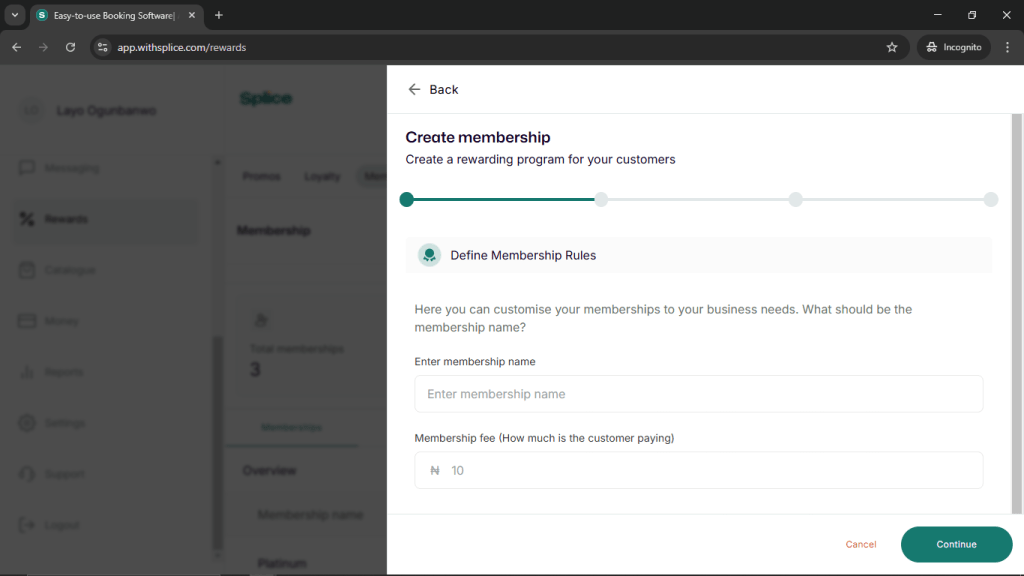
This way, you’ll be able to cater to a broader audience — retaining price-sensitive customers and upselling higher-end treatments.
Tip 6. Monitor and adjust your prices accordingly
Your prices may be right today, but they may not be effective in two months.
You must regularly review and adjust your prices to reflect economic realities like inflation, market trends, or new-found status. The beauty and wellness industry is dynamic like that.
Tip 7. Effectively communicate your value
It’s not enough to say your services cost certain amounts; you must ensure your clients understand the value they’d be receiving.
Effective communication about the quality of your products, the expertise of your staff, and the overall business experience of your target market can help justify higher prices to your customers.
Utilise every available marketing channel, including your website, social media pages, emails, and in-salon materials.
Tip 8: Use technology
Salon and spa management software like Splice that streamlines appointment booking and analyses sales data can help you identify your most profitable services and peak times. You can use this information to adjust your pricing strategy accordingly.

Conclusion
Getting your salon or spa pricing right entails striking a balance between employing a pricing strategy that will keep you profitable and affordable for your target market. This makes mastering how to set the right price for your salon and spa services an indispensable skill for a beauty business owner or manager.
By following the tips in this article, you can create the right pricing strategy that attracts and retains clients, ensures profitability, and ensures business growth.


