


Have you ever run out of gloves in the middle of a busy day or wondered why a product is gathering dust on your shelves?
Then it might be time to reconsider how you manage your stock.
If you’re like most beauty business owners or managers, you’ve likely read countless inventory management articles and explored various salon inventory apps. That’s because you understand that inventory management forms the backbone of any successful salon or spa business, whether in Nigeria or elsewhere.
Effective inventory management ensures smooth operations, satisfied customers, and steady profitability, from restocking essentials like shampoos and gloves to maintaining premium treatment products. On the other hand, poor inventory management can result in wasted time, lost profits, and dissatisfied clients.
In this guide, we’ll explore how to improve your salon inventory management.
What is salon and spa inventory management?
Salon inventory management involves tracking and organising the products and supplies your beauty business uses or sells.
The goal of salon and spa inventory management is simple:
To ensure your beauty business always has the right products in the right quantities without overstocking or understocking.
Why is effective salon inventory management important?
Here are some key benefits of managing your beauty business inventory effectively:
- Prevents overstocking or understocking. Overstocking wastes valuable space and resources, while running out of key supplies disrupts services. Effective inventory management ensures you maintain just the right stock levels.
- Reduces waste. Addressing overstocking and understocking reduces waste and helps save money.
- Increases customer retention. Few things frustrate beauty clients more than being unable to complete their favourite treatment due to a stockout. Keeping essential products and supplies in stock ensures you deliver consistent, high-quality service, fostering repeat business and customer loyalty.
- Boosts efficiency. An effectively managed inventory allows your team to work seamlessly and offer customers the best services. When supplies are readily available, staff can focus on delivering high-quality services without delays or confusion.
- Improves business insights. A clear picture of your inventory helps you identify trends, such as top-selling products, seasonal demand, or underperforming items. These insights let you make smarter business decisions
7 tips for better salon and spa inventory management
The following are seven tips to improve your salon stock management:
Tip 1. Categorise your inventory
Organise your inventory into clear, labelled categories to simplify tracking and management.
There’s no single way to do this.
For example, if you run a hair salon, barbershop, nail studio, or spa, you can categorise your inventory as follows:
- Retail items: Products and supplies you sell to customers (e.g., shampoos, hair cream, nail polish, serums).
- Consumables or back par: Items used during services (e.g., gloves, apron, acrylic nails, wax strips).
- Tools and equipment: E.g., dryers, clippers, buffers, massage tools, etc.
| S/N | Retail items | Back par | Tools/equipment |
However, if you own a beauty salon, you can, first of all, categorise your products and supplies according to the beauty services you offer, such as hair care, skin care, and nail care. Then, make sub-categories as follows:
| S/N | HAIR CARE | SKINCARE | NAIL CARE | ||||||
| Retail items | Back par | Tools | Retail items | Back par | Tools | Retail items | Back par | Tools | |
| 1. | |||||||||
Assign designated storage spaces for each category and label items with essential details like brand and expiration date. This not only saves time but also enhances customer experience.
Tip 2. Implement a first-in, first-out (FIFO) system
The first-in, first-out (FIFO) system ensures you use older products before newer ones, particularly those with expiration dates, to prevent waste. This is especially important for perishable beauty products that expire (e.g., moisturisers and lotions, nail polishes and primers, foundations and concealers, and dyes and gels).
How to implement FIFO:
- Make sure each product’s expiration date extends beyond the period you plan to use it.
- Arrange new stock behind older stock on shelves.
- Train staff to use or sell items from the front first.
- Regularly review expiry dates to minimise losses.
Tip 3. Use inventory reports
Take advantage of the Reporting & Insight capabilities of Splice management software. Use the reporting feature to monitor sales trends, product performance, and stock levels.

Reports help you:
- Identify slow-moving products
- Forecast demand.
- Plan to purchase more effectively.
For example, if a specific conditioner is rarely used, consider offering it at a discount or discontinuing it altogether to free up shelf space for more popular items.
Tip 4. Establish minimum and maximum stock levels
Use sales trend data to establish minimum (par level) and maximum stock quantities for each product, ensuring consistent availability without overstocking. Splice’s Insight & Reporting feature can help you with the detailed breakdown of your day-to-day sales (check “Tip 2”).
Knowing when it’s time to order and the quantity to purchase ensures you avoid running out of essentials while preventing overstocking.
For instance, if you sell an average of 40 bottles of shampoo weekly, set a par level of 50 bottles — the additional 10 will serve as a buffer for emergencies. Once stock drops below this, reorder to ensure you never run out.
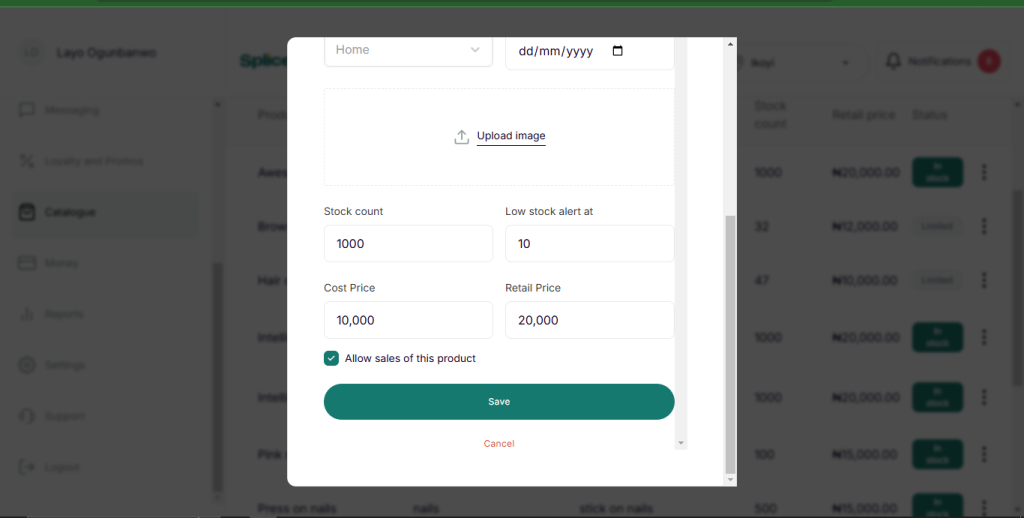
Set up a low stock alert with Splice
Splice can simplify this process with its low-stock alerts feature.
The low-stock alerts notification, an in-built inventory feature in the salon management app, will automatically send you low-stock notifications, informing you when it’s time to reorder certain products. This eliminates last-minute orders or desperate attempts to find the last bottle of something in your stockroom.
Adapt to seasonal changes
Inventory needs often fluctuate with seasons (e.g., Christmas holiday or Black Friday) or trends (e.g., hair colouring among Gen Zs). For instance, during Christmas, customers may demand more nail polish or festive hair accessories.
Stock up on products that experienced increased demand during peak seasons. Stay updated on beauty trends by attending industry events like Beauty Connect Africa 2024 or following influential stylists online, such as Fola Fash.
Tip 5. Conduct regular stock audits
Conducting regular audits ensures accurate records of what’s in stock, running low, or overstocked. Depending on the size of your inventory, set aside time (e.g., weekly, monthly, or quarterly) to physically count your inventory. Involve your staff to promote accountability.
Compare physical counts with system records to detect issues like theft or misplacement. Use insights from the routine exercises to refine your inventory processes continuously.
How to audit effectively:
- Use an inventory checklist that categorises items (check “Tip 1”).
- Check expiry dates on products to prevent wastage.
- Update your inventory records immediately after each audit.
6. Build strong supplier relationships
A robust inventory management system requires reliable suppliers. No matter how much work you’ve put into maintaining a consistent inventory, unreliable suppliers can hinder it. Establish relationships with trusted suppliers who can deliver quality products on time.
Some tips for working with suppliers:
- Negotiate bulk purchase discounts to save costs.
- Keep an open line of communication for quick resolution of issues.
- Have backup suppliers to avoid disruptions during delays or shortages.
7. Get an all-in-one management software
You can choose either a dedicated salon inventory app or an all-in-one management software with inventory features. If you ask us, we’ll tell you to go for the latter, not just because it’s easier and cheaper but also because we can vouch for Splice.
Besides cataloguing products, Splice software also automates the following:
- Appointment booking
- Customer relationship management
- Staff scheduling
- Report
- Payment
By centralising your operations in one software, you save time and ensure consistency across your business.
Conclusion
Effective salon and spa inventory management keeps your shelves stocked and lets you run a more efficient, profitable salon. By categorising products, setting stock levels, auditing regularly, and leveraging modern software like Splice, you can transform your inventory from a challenge to a competitive advantage.
Start today with these tips and take control of your salon’s inventory.


