


Running a successful beauty business relies partly on having the right skills and keeping up with the latest trends. But it’s also about structure. And structure starts with clear, consistent policies.
Think about it.
What happens when a client shows up late or doesn’t show up at all?
How do you go about it if someone keeps cancelling at the last minute?
What if a client requests a refund after a service has already been completed?
These scenarios can create awkward moments, lost income, or worse, frustration that affects your energy and the flow of your day.
That’s where salon and spa policies come in.
In this article, we’ll break down:
- Why every salon or spa needs policies.
- The core policies you should have.
- How to create ones that are clear, fair, and enforceable.
We’ll also explore how tools like Splice can help you enforce your policies easily, without awkward texts or back-and-forths.

Why policies matter for your beauty business and your clients
Policies are not about being rigid or unfriendly; they’re about protecting your time, your income, and your peace of mind. Without them, you’re leaving your business open to chaos, misunderstandings, and revenue loss.
Here’s why salon and spa policies are non-negotiable:
1. They set clear expectations.
Clients know what’s okay and what’s not, whether it’s how late they can arrive, how cancellations work, or what payment methods are accepted. This reduces confusion and builds mutual respect.
2. They help you manage time better.
Last-minute cancellations or no-shows can leave gaping holes in your schedule. A good policy helps reduce these situations and gives you room to charge fees when necessary.
3. They protect your revenue.
Without boundaries, you risk giving away free time, services, or unnecessary second chances. Policies help you stay in control and ensure your time is valued.
4. They promote professionalism.
Having written, clearly communicated policies shows customers that you take your business seriously. It builds trust and makes people more likely to treat you with respect.
5. They reduce awkward conversations.
Instead of having to explain things on the spot or argue with a client, you can refer to your established policies. It takes the pressure off you personally, as the policy becomes the “bad guy,” not you.
The 6 most important policies every salon or spa should have
You don’t need to write a multi-page rulebook. There are, however, a few key policies that every beauty business, big or small, should have in place.
These are the ones that directly protect your time, your revenue, and your client relationships.
1. Cancellation and rescheduling policy
This is non-negotiable. Life happens, but last-minute cancellations or constant rescheduling can impact your productivity and earnings.
Your cancellation policy should include:
- Minimum notice required for cancelling or rescheduling (e.g. 24 or 48 hours).
- Any fees for late cancellation or no-shows.
- How clients can cancel or reschedule (e.g. via call, WhatsApp, or app).
Example:
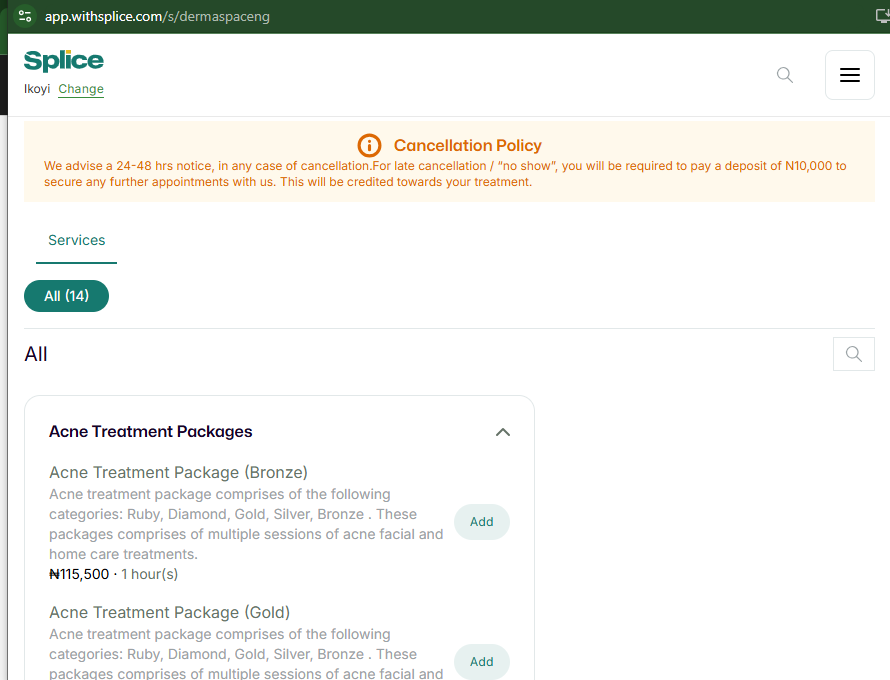
“All cancellations should be made at least 24 hours before the scheduled appointment. Cancellations made less than 24 hours before your appointment will attract a ₦10,000 fee.”
How Splice Helps: Splice allows you to set clear booking rules, enforce cancellation deadlines, and automate reminders, making your policy easy to follow and hard to forget.
2. Late arrival policy
Some clients will run late. You need to protect your schedule so one client doesn’t make you late for the rest.
You need to spell out:
- How many minutes late is considered too late?
- What happens if they arrive late: shorter service? New time? Forfeit appointment?
Example:
“Arriving more than 15 minutes late may result in a shorter session or cancellation of your appointment.”
3. No-show policy
A no-show is the worst. Time is blocked, clients don’t show, money is lost, yet no explanation. Having a strict but fair no-show policy discourages this and protects your business.
When considering your no-show policy, consider stating:
- What counts as a no-show.
- No-show penalties (e.g. full charge, loss of deposit, ban from future bookings).
- How repeat offenders will be handled.
Example:
“No-shows will be charged the full cost of the service before they can rebook.”
4. Payment and deposit policy
Be clear about how and when you expect to be paid. A deposit protects you, especially for longer sessions or new clients. It filters out unserious bookings.
What to include deposit policy:
- Accepted payment methods.
- When payment is due (before or after service).
- When a deposit is required (e.g. for appointments above a certain amount or all).
- Amount or percentage
(e.g., 40% of full cost, ₦10,000, etc.) - Is it refundable? Non-refundable? Transferable to a new date?
Example:
“A 50% deposit is required to confirm your appointment. Deposits are non-refundable for cancellations under 24 hours.”
How Splice Helps: You can collect deposits, track payments, and integrate your policies into the booking process — so there’s no confusion when it’s time to pay.
5. Refunds and redo policy
Sometimes clients aren’t satisfied. Clearly stating what you’ll redo and won’t can save you drama. You want to be very clear here, including stating the:
- Conditions for a refund or redo (e.g., complaints within 48 hours).
- Non-refundable services.
- Timeframe for returns.
Example:
“We offer complimentary fixes within 48 hours if you’re not satisfied. No refunds on services already performed.”
6. Children and extra guests policy
You need to control your space. Say it up front if your salon or spa isn’t set up for kids, crowds, or pets. In your policy, also add if exceptions can be made or if guests must wait in the waiting area.
Example:
“Due to limited space and for the comfort of all clients, we kindly request no extra guests, children, or pets during your appointment.”
How to communicate policies to clients without scaring them away
Having clear policies is one thing. Communicating them is another.
Many salon and spa owners hesitate to enforce their policies because they don’t want to come off as harsh or drive clients away. But the truth is, when done well, sharing your policies can actually boost your credibility and client trust.
Here’s how to communicate your salon or spa policies in a way that feels professional, friendly, and client-first:
1. Be upfront and transparent
Don’t hide your policies in tiny print. Share them clearly from the moment a client makes a booking, whether on your website, booking page, social media, or even physically displayed in your space.
If you’re using the Splice app, you can include your policies directly in your booking confirmation and reminder messages, so clients always know what to expect.
2. Use warm, friendly language
Instead of saying “Lateness beyond 10 minutes will lead to automatic cancellation,” try: “We understand that life happens. If you’re running late, kindly let us know within 10 minutes so we can do our best to accommodate you. Otherwise, we won’t be able to attend to you.”
Keep it professional, but human.
3. Train your staff
Ensure everyone on your team is on the same page. Your receptionist, stylist, or therapist should all be able to gently explain your policies if needed.
4. Reinforce consistently, not aggressively
Consistency builds credibility. If you waive the rules too often, clients won’t take them seriously. But if you enforce them with empathy and grace, clients will respect your boundaries.
5. Let technology support you
Tools like Splice can make this easier. From auto-reminders to customizable message templates, you can reinforce your policies without sounding like a broken record.
Review and adjust your policies when necessary
Policies aren’t “set it and forget it.” As your beauty business grows, your team expands, your clientele changes, and the economy shifts, your policies need to evolve too.
Here’s how to keep your policies fresh and relevant:
Review at least once or twice a year
Set a reminder, maybe every June and December, to sit down and look over your existing policies. Ask relevant questions:
- Are they still serving you?
- Do they reflect your current business realities?
- Are clients or staff regularly confused about certain rules?
Track what’s working and what’s not
Keep an eye on common issues.
- Are you seeing lots of late arrivals?
- Repeated complaints about certain charges?
- A high no-show rate?
These could signal where a policy is missing or where an existing one needs tweaking.
Ask for feedback
Your staff and even loyal clients can offer insight. They might highlight areas you hadn’t considered or help you spot gaps in how you’re communicating your policies.
Stay flexible but firm
Sometimes you’ll outgrow a policy, like a fixed pricing model that no longer covers rising costs. Or you might need to introduce new ones to handle challenges like appointment abuse or payment delays. Just make sure changes are communicated clearly and with notice.
Conclusion
Setting policies might not feel like the most exciting part of running a salon or spa, but it’s one of the most important. Clear, fair, and well-communicated policies help protect your time, energy, team, and bottom line. They make it easier to run your business without confusion, resentment, or burnout.
If you don’t have many policies in place yet, don’t feel overwhelmed. Start with just two or three essentials, like a cancellation policy, payment rules, and late arrival terms. You can always build from there.
And remember:
- Policies are your business’s boundaries. They help you work smarter, not harder.
- People will respect what you enforce consistently.
- Tech like Splice makes it easy to apply your policies automatically, from booking to reminders to payments.
So don’t wait until peak season or a client crisis to set the rules. The earlier you put them in place, the smoother your operations and your peace of mind.


