

Running a hair salon means managing people, products, money, and clients while staying ahead of trends. But many beauty business owners overlook the importance of knowing the industry’s language.
Every industry has its language. The beauty industry isn’t different. From technical styling terms to business and management lingo, understanding salon vocabulary makes communication smoother, with clients, with your team, and even with your suppliers. It also helps you run your business with clarity and confidence.
That’s why we’ve put together this hair salon glossary, a handy guide to the key terms every beauty business owner should know. Whether you’re a seasoned pro or just starting, consider this your quick reference to sounding and operating like the expert you already are.
60+ key terms every hair salon owner or manager should know
To make things easier, we’ve grouped the glossary into five categories:
- Hair treatment and styling techniques.
- Hair anatomy and science.
- Haircare products and tools.
- Hair salon business and operations.
- Hair salon roles.
This way, you can quickly find what matters most to you and apply it directly to your business.
A. Hair treatment and styling techniques
Here are key terms every stylist and client should know about hair treatment and styling:
- Balayage: A freehand hair-colouring technique that creates a natural, sun-kissed look.
- Blending: Seamlessly merging different lengths or colours of hair for a smooth finish.
- Blowout: Washing and styling hair with a blow dryer and brush for a sleek, voluminous look.
- Blunt cut: A haircut with ends cut straight across, with no layers.
- Brassy: Unwanted warm, yellow, or orange tones in colour-treated hair.
- Colour correction: A salon service to fix undesirable colour results, such as uneven tones.
- Deep conditioning treatment: An intensive hair treatment that restores moisture, shine, and strength.
- Dusting: Trimming just the very tips of the hair to remove split ends without changing the length.
- Feathering: A cutting technique that lightens thick hair by removing bulk, leaving soft, layered edges.
- Foiling: Sectioning and wrapping hair in foils for precise highlights or lowlights, for controlled, precise colour placement.
- Framing your face: Strategic cutting or colouring to accentuate facial features.
- Highlights: Lighter strands added to the hair to create contrast and brightness.
- Keratin treatment: A smoothing service that reduces frizz and strengthens hair.
- Layers: A haircutting technique where hair is cut at different lengths for movement.
- Lowlights: Darker strands added to the hair to create depth and dimension.
- Ombre: A gradual colour fade from dark roots to lighter ends.
- Protective styles: Hairstyles (e.g., braids, weaves, or twists) that are designed to protect natural hair from damage.
- Patch test: A pre-treatment safety procedure (usually behind the ear) to check for allergic reactions to treatments like hair dye or toner.
- Texturising: Cutting or thinning hair to remove bulk and add movement.
- Tinting: Applying semi-permanent or permanent colours to darken or lighten hair.
- Toning: The final step after lightening, applying a demi-permanent colour treatment to neutralise brassiness or fine-tune shades.
- Treatments: In-salon services for scalp health, hydration, or damage repair.
B. Hair anatomy and science
Understanding the structure of hair helps stylists diagnose problems and recommend the right treatments.
- Body: Refers to the volume or fullness of hair.
- Cortex: The middle layer of the hair shaft that determines strength, colour, and texture.
- Crown: The top, back section of the head, often used as a reference point in styling.
- Cuticle: The outer layer of the hair shaft, made of overlapping cells that protect the cortex.
- Hair elasticity: The ability of hair to stretch and return to its original shape without breaking.
- Porosity: The hair’s ability to absorb and retain moisture or chemicals.
- Trichology: The scientific study of hair and scalp health.
- Virgin Hair: Hair that has never been chemically treated.
C. Haircare products and tools
These are the products and tools that keep a salon running:
- Conditioner: A product that softens and nourishes hair after shampooing.
- Developer: A peroxide-based product used with colour to lift and deposit pigment.
- Diffuser: A blow dryer attachment for curly/wavy hair.
- Extensions: Added hair (synthetic or natural) to increase length or volume.
- Flat Iron: A heat tool for straightening.
- Foils: Thin aluminium sheets that are used to isolate hair sections during colouring, prevent bleeding, and speed processing.
- Gel: A jelly-like styling product used to create hold and definition.
- Mousse: Lightweight foam for volume and hold.
- Protective spray: A product applied before heat styling to prevent damage.
- Salon chair (stylist chair): The professional salon chair where clients sit for services such as haircuts and styling.
- Shampoo: A cleansing product for removing dirt, oil, and product buildup.
- Styling products: Gels, mousses, and sprays that are used to hold or shape styles.
- Tint: A semi-permanent or permanent colour applied to the hair.
- Toner: A product that adjusts unwanted tones (like brassiness) after colouring
D. Hair salon business and operations
The following are some of the most common business and operations terms every beauty business owner should know:
- Appointment book: A system (paper or digital, like Splice) for scheduling clients.
- Booth rental: A setup where independent stylists rent a chair or station in a salon and operate as independent contractors.
- Break-even point: The point where your revenue equals expenses.
- Commission: A percentage-based payment system for stylists based on services or product sales.
- Front desk management: The processes involved in welcoming clients, handling bookings, and keeping daily operations organised at the reception area.
- Gross revenue: The total income generated before expenses.
- Inventory: The products and supplies your salon uses or sells, like shampoos, colour kits, and retail items.
- Net profit: The actual profit after all expenses are deducted.
- No-show: A client who misses their appointment without notice.
- Overhead: Ongoing business expenses such as rent, utilities, and supplies.
- Point of Sale (POS): System used to process transactions and sales.
- Retail sales: Selling salon products to clients for at-home use.
- Roster/shift scheduling: Organising staff work hours and responsibilities. Splice can help you manage this.
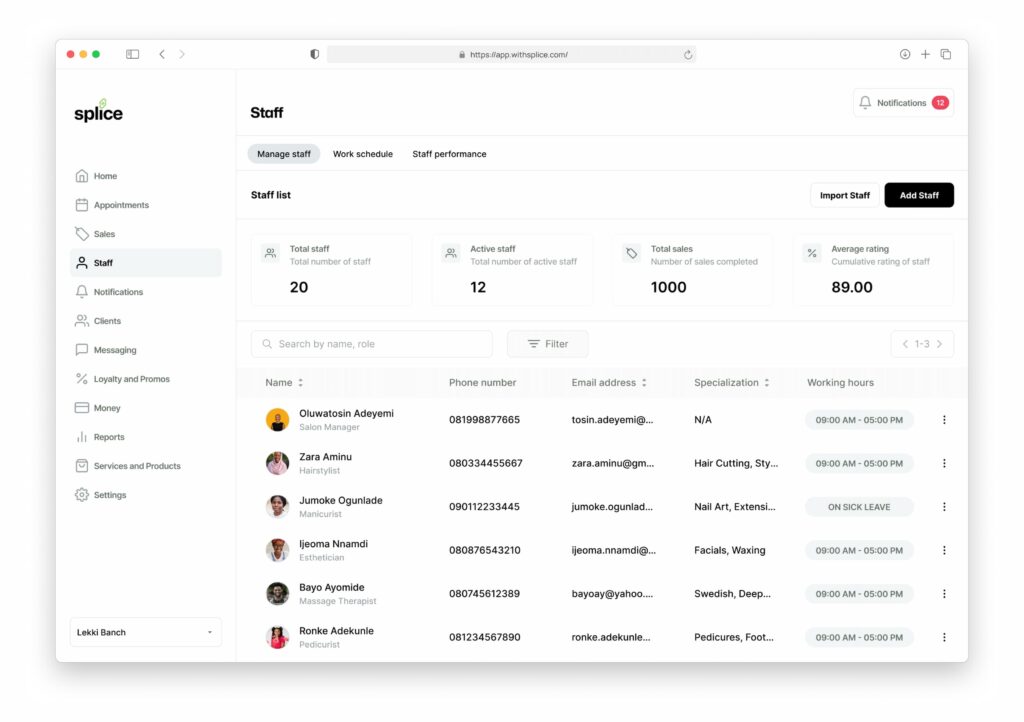
- Splice: A salon and spa management tool that helps owners handle bookings, payments, client communication, staff scheduling, and inventory in one app.

- Walk-in: A client who visits the salon without a prior appointment.
E. Hair salon staff roles and certifications
Every salon thrives on the skills of its team. Here are the key roles.
- Colourist: A stylist who specialises in hair colouring services.
- Salon manager: The person whose job involves overseeing the day-to-day operations, staff management, client service quality, and revenue goals.
- Salon assistant: Provides support to stylists by shampooing, prepping, and maintaining cleanliness.
- Stylist: A trained professional who cuts, styles, and treats hair.
- Trainee/apprentice: A new stylist gaining practical experience under supervision.
Conclusion
Getting a grasp of hair salon terminology is about building professionalism, confidence, and trust. The right words help owners train staff better, explain services clearly to clients, and run operations more smoothly.
Use this glossary as a go-to reference for yourself and your team. With time, you’ll find that fluency in salon language isn’t just good for business; it makes the salon experience seamless for staff and unforgettable for clients.


